Saturday, 5 September 2009

Paintings

I've been thinking about desktops. Everybody needs a good one, be it a cuddly kitten or Metallica album cover. I've have had some good ones in the past, but lately I've been trying to find paintings I've liked in suitable high resolution. I dunno, maybe I'm getting snobbish. Wikia Commons was a great place to get started, but the search engine was not exactly sophisticated and it has proved to be impossible to cull out the smaller images. On the other hand, Google Image has gotten a lot better since sometime in the recent past they added the possibly to eliminate pictures of less than certain amount of megapixels (as opposed to "less than big", which was too vague or "less than 1024x800" which in turn was too strict).

Today I hit the mother load - so to say - with the flickr-stream of Freeparking. 19th century art is one of my favourite things, and I was thus happy to find such an amount in good resolution. What joy!

Some of my favourites follow. Alas, blogger makes them so small and insignifant; clicking helps but they are still not on the resolution to be found on my hard dirsk. Maybe you are able to locate them somewhere else again (or you can always hit me with an email, I suppose!).

Andrew Wyeth - Christina's World


Frank Dicksee - The Confession

Jeffrey Jones - Blind Narcissus (detail)

Mary McKenzie - A Nude Study

Viktor Vasnetsov - The Flying Carpet

Romaine Brooks - The Cross of France

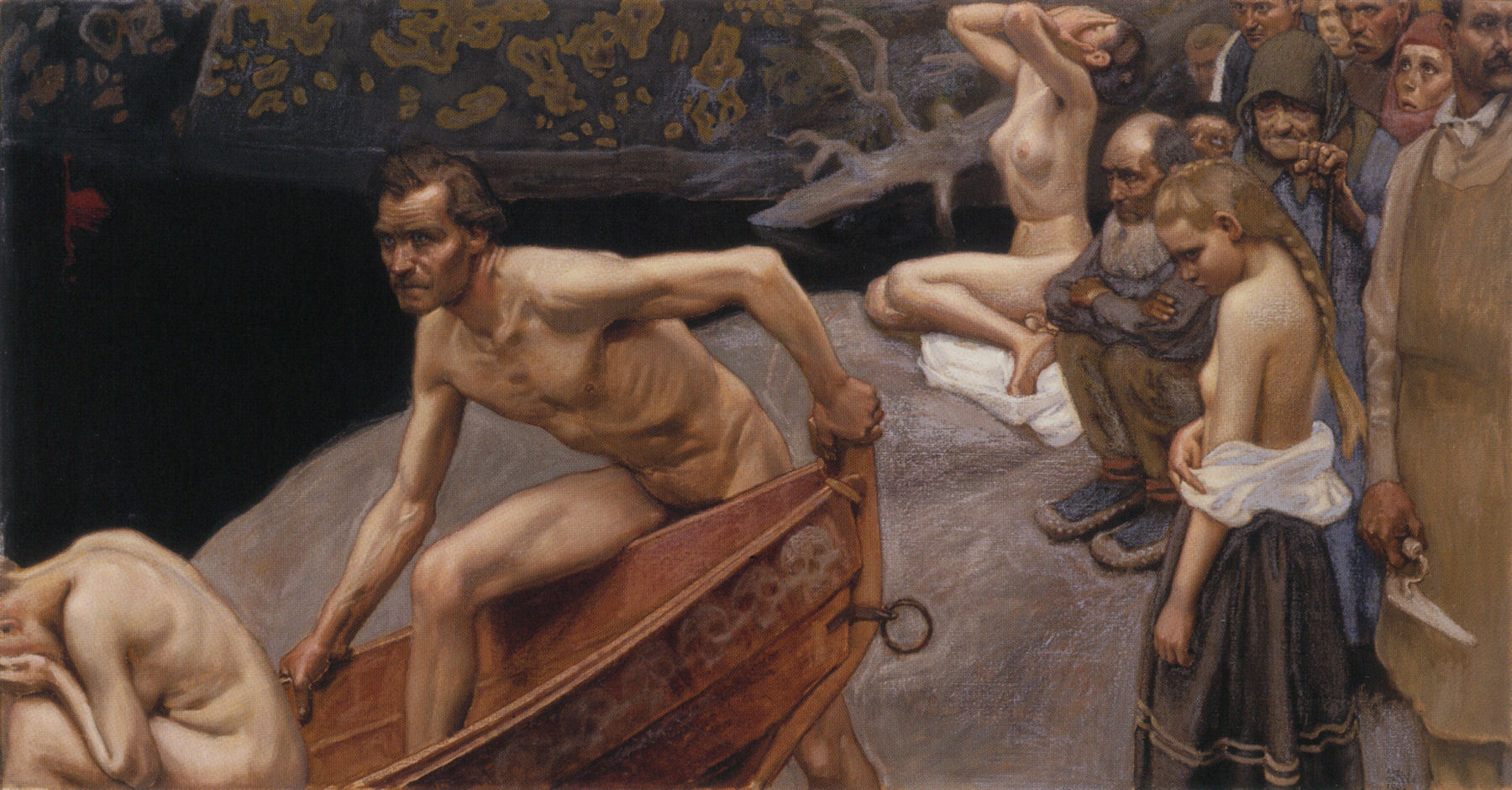
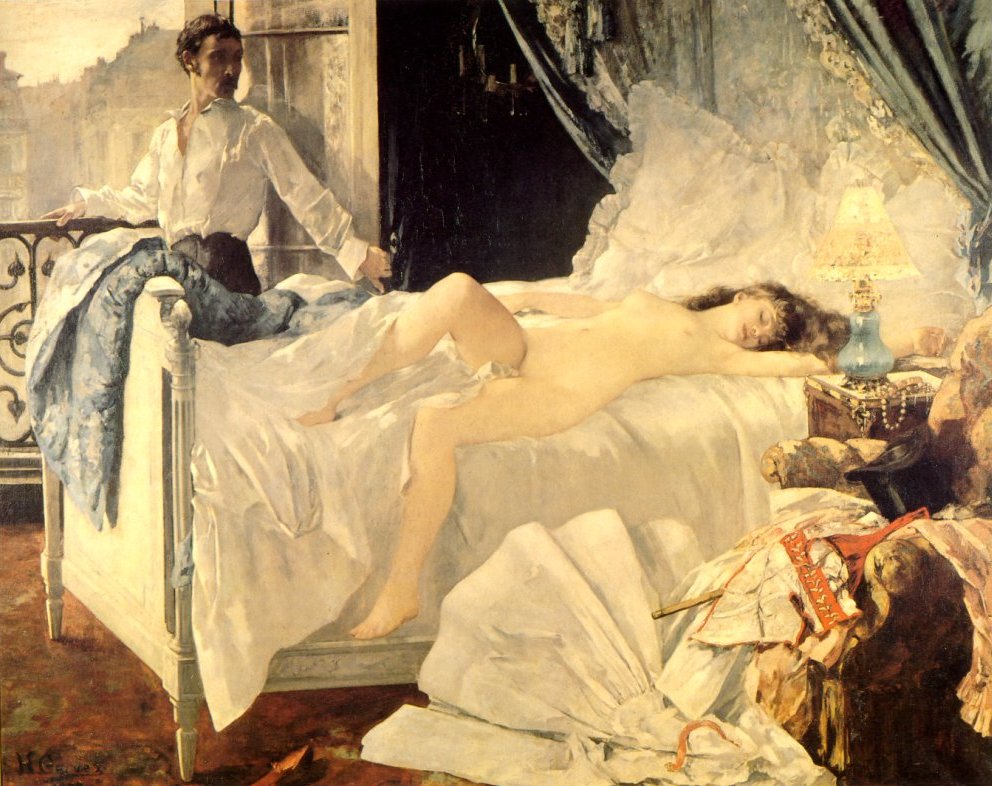
Next I probably have to hit the library. I'd really like to find a good high quality scan of Gallen-Kallela's At The River of Tuonela or of Henri Gervex' Rolla. Apparently none exist in the Internet today. I suppose I wish to give something back and produce one.. Gallen-Kallela's work is easy enough to find, I think.

Friday, 21 August 2009

American in Scandinavia

Got the following email from a friend living abroad;

Here: http://econlog.econlib.org/archives/2009/08/denmark_and_swe_1.html

Thought I'd share this with you to get your input.
In short, the writer critiques Scandinavian (and Danish and Swedish in particular) living standards from those portrayed in the popular media. He claims that Scandinavian people are poorer, less happy and have blinds concerning their surroundings and taxation general.

My first reaction was amazed disbelief: surely this is a text from The Onion? After thinking about it a moment, I can see he has some good points, but ultimately they are all drowned by his inability to see the achievements and advantages of the Nordic model from its failures and differences to the American model.

Before going further into his points, I'd like to talk about his text as a whole. The important part of mr. Caplan's argumentation stems from the question of values. To understand his text, we must see that he is comparing what's good in America into how Scandinavia rates in comparison - but not vice versa. This of course is fair, if we are talking about certain singular datapoints - which has the fastest cars, for example? Cheaper gasoline? I'm sure you have seen this to be used in marketing texts: our product compared to competitor's mark X! Seeing the technique used in a text written by a professor into something I assume to be prestigious website with a high-brow reputation.. well, it is to be seen!

Of course, there are some things we simply can't argue with; how Scandinavia looks compared to Swizerland or New Jersey, for example. Apparently Caplan travelled the countries extensively and can make such arguments. I've never been to Denmark or New Jersey; I remember very little of my trip to Switzerland. Obviously Caplan has been to all these places, and feels that he can, with authority, say that this is indeed so.

What I find particularly amusing is his claims about the things that make life worth living; living space, car ownership, and meat consumption (instead of time spent with family/friends). He writes with sneer about people biking to work in rain, apparently ignoring several observations that you can make from this;

First, that a person who has stable income can surely afford a car of some condition.
Second, that biking to work is possible in the first place.
Third, that the biker assumes he is still in presentable condition once he gets to the workplace.
Fourth, that a people who regularly exercise tend to be healthier and thus, happier (that I'm actually linking to Fox should tell you how well-known fact this is!).
Fifth, the biker calculates that he can still fill all his social obligations even though his commutation time increases. In other words; even though he has less time to spend with friends after work, he will find a way to make up to it in other ways. Maybe he works shorter days or his friends are available at weekends

Meat usage seems somewhat strange on the list; surely this is a question of taste, values and history rather of money?

And so on. Caplan makes lots of assumptions that are understandable as personal opinions from a private individual (after all, we seldom form our views from "fairly balanced" pool of information) but rather less so from a professional blogger, who, I assume, was hired for his interesting and in-depth vision. This blog-post is a collection of knee-jerk reactions - mostly ones he had even before he left the States. He would have been interested in confirming these solely based on his earlier journal entries. There was no initiative to actually deny any of them...that is to say, contradict himself. Even though he might have walked in with an idea to go where the wind would take him, his hypotheses would have fast blinded him to any advantages to American system he may have seen, maybe even presenting them to him in negative light.

After all, few of us work very hard to make ourselves look like idiots.

A hint into his psyche can be found in this quote;

[About Human Development Index];
I can see giving equal weights to GDP per capita and life expectancy. But education? [...][I]n terms of the actual if not professed values of normal human beings, televisions and cars are a lot more important than books.

All

Sunday, 9 August 2009

Political views


Just did a test of my political views, with the results on the left.
The nice thing about the test was the ability to check how certain groups, divided by age, nation and/or self-announced political groups answered the same questions. I note that I'm a bit farther away from the centre than my age group or the generation of my parents.

I was interested in the views of my own age group from natural reasons.. and of my parents' generation as these are the views from which the newspapers are edited, laws are made and from which moral arguments that the youths challenge usually stem from.

I wonder though - am I on the left (and down) of my generation and my parents' generation because of my views.. or because the control group, the other people who answered the quiz happen not to represent a good average Finn of that age (and to admit, 11 people in the older group does seem a rather small sample)? This would have to do with where the link has spread, and who have thought to click on it, or do the test (which was fairly long). Also would have been interested to see the views of people in larger towns compared to countryside, but this was apparently not possible.

But I have long suspected that the people that write opinions to news stories on the Internet ("niggers go home! finland is to white people! pure race!") may be closer to "average citizen" than those well-phrased texts in the daily paper's Letters-section. I am not entirely comfortable with this idea.

Political Spectrum Quiz

Sunday, 2 August 2009

My trip in Sweden

Two weeks ago I left for a biking trip. I took the ferry for Stockholm and two weeks later I was in Rostock looking a way home. Attached is the route as mapped by my GPS and the markings I did to my notebook. The text will go from present to imperfect, hopefully it's easy enough to follow.

15.7.2009 - Wednesday
Backed the last of my stuff, took the train to the harbour, bought a ticket and left for Sweden. Planning to bike to Helsingborg, take a ferry to Denmark's main island, cross it and from there take a ferry to Rostock.

16.7.2009 - Thursday
distance covered 122,5 km/ av. speed 15,4 km / in 7:55 hours

Got out of the ferry around ten, biked to the motorway to Helsingborg. Found out that the road is - despite publicity - not good for biking. Have to backtrack and start using older roads.

Traveled quite the distance. I decide to not go for a camping site because it would have meant sidetracking at least 7 kilometres, instead went forward for another 20 and slept on an untended farmland, behind some trees.

17.7.2009 - Friday
99,6/16,3/6:04
After biking four kilometres there is the county beach. I spent there few hours washing my hair, eating food etc.

Because of the wind direction, traveling seemed slow and I had to keep breaks quite often during the first 40 kilometres. After reaching Katrineholm, I went for the south, with wind somewhat on my back. I see a map with a camping site marked inside the city borders of Norrköping. Travelled thru beautiful Åby and reached Norrköping around 21; trouble finding the camping site and had to ask directions from a cop, who decided to drive the patrol vehicle to the camping ground, so I could follow him.

Reception closed, but I'm assured I can just build the tent, use the showers et al and pay in the morning.

18.7.2009 - Saturday
91,1/14,1/6:25
Payment in the morning was successful. The price was 120 crowns (around 10 euros) for the night and 130 crowns for purchasing Scandinavian Camping Card, which is apparently required for most camp sites. I also get a a magazine with all the Swedish camping sites marked on a map. Looking at the map, I feel overwhelmed by the distance I have yet to cover.

Spent the better part of the day walking about Norrköping. Left for South around 14, but again against opposite wind. Decide to follow unpaved roads toward West, in hope of getting the wind of my back. Somewhat success, but the roads are not straight and inadvertently circle back toward itself. High point was following a road that slowly dwindled into nothing and I had to carry the bike over a hill to reach another road - only to find hundred metres later it blocked by barbed wire, to make it part of a cow pasture. While carrying the bike and the bags one at a time over the fenced area (and crawling under the wire myself), it started raining, which thankfully lasted only for an hour.

Found out that not all the smaller places marked on the map actually have a store or other places where refreshments could be found. Started to travel toward Kisa, but found a pleasant camping site on route, by a lake, and decided to build the tent there.

19.7.2009 - Sunday
47,5/16/???
Woke up to the sound of water hitting the canvas. Decided to stay in the tent till the rain would end. It continued till 16, with feeling that this would be temporal break. Calculated that I didn't have enough cold food till tomorrow (couldn't very well use the cooking equipment in the rain) and decided to push forward. I did have some canned beans, but for some reason didn't have a can opener.

Got to Kisa after biking most of the day in rain. Found a camping site, where the land owner said I could pay when I was leaving, at which time I would know the total of my bill.

20.7.2009 - Monday
71,1/15,8/4:38
The rain continued till 16. I settled my account and went forward. Only after few kilometres the rain continued, but thankfully didn't last long. It returned frequently for short bursts thru the evening.

Found a kebab-restaurant, the first I had seen after leaving Stockholm. The owner was from Macedonia, and observed that while business was good in the village where the restaurant was located, it had no social life and the only entertainment was the frequent fist fights the farmers started on pub nights.

Continued toward Eksjö through some beautiful scenery, which didn't easily copy itself to a film. Did try, though. Reached Eksjö quite late at night, but for lack of sleeping place pushed forward. After about ten kilometres, found a good spot in the forest.

Heard some loud, strange voices from the forest that didn't seem to belong to a human. While loud and seemingly coming from a large body, didn't see anything and slowly the voices faded away.

21.7.2009 - Tuesday
73,9/14,4/5:06
The opposite wind became even worse. I had to walk for kilometres at a time because the wind changed direction every other minute, making the bike difficult to drive. Sometimes the wind pushed me to the gutter, sometimes in front of the cars. Thankfully nothing happened, but I chose to walk for kilometres instead of risking it.

The weather continues to be bad otherwise as well. Rain keeps falling sporadically.

The battery of the camera seems to be running low. I have been taking too many pictures; over 200, though it felt like less.

It is hard to push forward. I don't really get to talk to people with whom I have history, and the lack of human contact depresses me. The road ahead seems far, and while I'm certain I can do it, it seems long and thankless journey. I was hoping for more effortless journey; the wind robs 5 to 10 kilometres per hour from my speed. At one point of the day I was going downhill, pushing for more speed and still had trouble passing 15 km/h.

22.7.2009 - Wednesday
86,0/19,4/4:23
Before going to sleep last night I called my mother. The call must be somewhat expensive, but it lifted my spirits. I also decided to go for Malmö and Trelleborg instead of Helsingborg and Denmark (the route would have taken me farther north). This allowed me more space on which to plan my journey.

The day was exellent in other ways as well. For most of the day the wind was behind me and went speeds of 25km/h even uphill. While the pace slowed down as the dark neared, I still covered most of the distance that day in less than four hours.

I stopped to visit county museum, which was mainly centred around nostalgia toward bygone Sweden. I also saw huts on which military used to live on the area.

Slept on camping site. I'm nearing Malmö, only about 150 kilometres as bird flies. As I still have two weeks before I have to get back to work, I'll take some sidetracks to see some of the bigger towns.

23.7.2009 - Thursday
76,4/16,8/4:31
I woke up in the rain, which lasted till 13, when I started biking. The trip to Kristianstad on smaller roads was was rather uneventful, though I did get to photograph a (Swedish) mile-stone, which I had seen through the whole week. This was the one in the best condition thus far, and I'm happy to finally gotten one. The stones for full miles (and one fourths, two fourths and three fourths) have followed me the whole trip. Apparently the miles (which equal ten kilometres) are still used for longer distances, as I few times heard people referencing to living "ten miles north" or traveling "180 miles to Lapland". With the milestones being so common, I would well see why this habit would continue when all the modern signs are in kilometres...

I reached Kristianstad soon enough, but found the outskirts disappointing. This was the first time in Sweden that I saw things being run-down. Thus far, no matter the construction costs, the houses (if not abandoned) were always in good condition and the people living in the houses seemed to have pride in them.

I had forgotten one my bikelocks at the camp site, and was advised to seek a new one from Biltema. Had troubles finding the place, and when I did, the store had already closed, at 19 o'clock. Thankfully, there was a camping site not half a kilometre away. The place was in the middle of the industrial area, which apparently had grown around the old vandrarhem. The price for a tent place and shower was the cheapest on the whole trip - 75 crowns, which included everything.

The staff was quite helpful and likeable, but when asked about the condition of Kristianstad, they reinforced my view of the place as run-down town with no future.

I started feeling regrets for doing the detour for Kristianstad, instead of heading straight to Malmö.

24.7.2009 - Friday
70,7/14,9/4:44
Bought the lock from Biltema and headed for the town centre, which ended up being a lovely old town. Spent time in town museum and then wrote some postcards.

Left toward Malmö around 16, when it promptly started raining again - while I stayed put, it had been all sun. Again I drove against wind, and for some unknown reason there was no way to reach Malmö directly by bike, thanks to the road being part of the European road network, on which biking is forbidden. I had to use old tractor roads, and the (very poor) road went like letter "S" on both sides of the motorway. I didn't do much distance that day, but I did tire myself to the largest extend during my trip.

Reached a camping site, where I met friendly people. Decided to rest for a whole day, the first since I got to Stockholm.

25.7.2009 - Saturday
Stayed put. The camping site was rather expensive (180 crowns for a tent place), but as the weather stayed abysmal I had no rush to get back on the road. Spent time with the campers and surfed the internet on my ipod.

26.7.2009 - Sunday
108,1/15,6/6:55
Today I biked to Malmö through Lund. The trip was, again, against wind. This is apparently a common occurrence as the trip saw me crossing several wind power plants that were busy grinding energy.

Lund had a beautiful old town, and soon after I left it I came to the outskirts of Malmö, which was, again, a bit of a disappointment; it was very similar to Kristianstad. Only the very centre with its houses from middle ages were worth seeing. After touring a while, I left for Trelleborg, from where I hoped to catch a ferry to Germany.

After getting only ten kilometres away from Trelleborg, the biking road ended and E-road started. While it had a sign forbidding bikers, there was a good paved 2 metre distance on the other side of the outer white line, on which I could travel far safer than on some other parts of Sweden. Reached Trelleborg and found that the ferry to Rostock would leave in four hours - at 23:00. Got tickets to it. Slept very badly on board.

27.7.2009 - Monday
69,5/13,2/5:13
I set my wheels on German ground at five in the morning. Was surprised to notice that there was a nuclear power plant right next door to the harbour.

I biked a while and slept in the forest waiting for the TallinkSilja's offices to open. When they did, I found out that the next boat to Finland would only leave at Wednesday and it would be full.

I tried to find alternatives on the city library's computer, but alas, the computers were from the 90s and still ran Windows 2000 with Internet Explorer 5.5. Most of the webpages I were depending on didn't open. In the end I called my mother who was able to secure me a place in the ship.

She also urged me to go get the ticket from the office as fast as possible, and to sleep "at least one night" in a proper bed.

Thus far I have probably not mentioned that the roads in Rostock were abysmal for biking. While the car roads were in good condition, the biking/walking roads were rised and seldom were the needs of bikes observed. Also, these roads were not paved but plated with cement squares, which were not even. This made travelling quite uncomfortable. The roads were also filled with unused tram-lines, which made it important to look down in order for the wheel to not get stuck. When we also add that on certain crossing there was only one pedestrian light, which had been situated thus as biker's eye would not reach it, it became understandable that I didn't see a car gaining speed from a crossing (apparenty the driver figured that green light was enough of a moral high ground to drive a biker to the ground). Thankfully he was turning and not going ahead, or I would probably not be here writing this.

Long story short, he hit me (apparently thinking that a bike could easily avoid a car if properly motivated, not counting on the quite tired driver or the additional weight of travelling gear). The car's bumber got some scratches. The driver insisted on calling the police, which after some problems (nobody understood English) ended with me fined (for 120 euros) and my insurance details being written down.

I got the ticket, and went on to try to find a sleeping place. Alas, all the hotels were full, and even the local camping site had only one spot left, of which they asked 43 euros. I didn't accept, and instead slept in the woods.

28.7.2009 - Tuesday
20/???/???
Woke up and went to long and beautiful beach which was the whole seafront of the area. Spent there several hours. Lost my glasses in the sea, and found it rather tricky to bike back to TallinkSilja offices, at which the ship would be boarded on midnight for departure in 5 in the morning on the following day.

29.5.2009 - Wednesday
Spent sleeping at the ship.

30.5.2009 - Thursday
Mother fetched me from the harbour and drove home. Feeling pretty ok, but as the hours passed the trip starts to get me down, with my knees and hands aching in particular.
..

If I would have to do the trip again, I would perhaps more closely follow the seacoast, instead of so readily biking west. I have a feeling that the roads would have been better suited for bicycle travel there, but this theory will have to go untested. All in all the trip was quite satisfactory, though maybe a tad too long by myself. In the future, I would probably either find a friend to accompany myself, or limit the trip to 500 kilometres. Longer than that seem to cause depression for lack of human contact.

The people in Sweden were surprisingly friendly. In towns, the people readily and cheerfully helped me when I didn't understand how some machine worked (such as the card-readers in stores), and while on the road they gave me a good girth, so not once did I feel I was in danger, even when I was driving with the cars. Indeed, when I was driving late at night, the cars slowed down, honked and showed me a thumb in support, for having the stamina to continue after sun had set.

This all changed at Rostock. The people were, by and large, quite unpleasant. The cars seemed to try to intentionally make my life miserable and did not take me into consideration when plotting the courses. This went to such lengths that one hit me rather than tried to avoid me. But of that I have already told you enough!

All in all, the trip was quite satisfactory, and I will endeavour to do something similar next year.

Monday, 13 July 2009

Mitä löydän kun tulen kotiin viikon pyöräretkeltä:

"Ohhoh, miksi tuo kirja on lattialla? No heitänpä hyllyyn.."


No.. se siitä sit.

Wednesday, 17 June 2009

Tutkimusretki Pornaisiin II

Jatkoa edelliselle viestille.


Hylättyjä pikkutaloja nyt löytyy vähän jokapuolelta;

Hylätty parin huoneen talo lähellä Keravaa.

Mutta isompia yksiköitä ei niinkään. Siksipä yllätyin kun törmäsin kokonaiseen hylättyyn maatilaan Järvenpään itäpuolella;

Päärakennus oli rakennettu kivestä ja näyttää vanhemmalta ja huolellisemmin rakennetulta kuin varusmies-talot yleensä. 1900-luvun alkuvuosilta?

Sisältä talo oli epäsiisti, mutta suurin osa ikkunoista oli yhä ehjiä ja talossa oli vain kaksi grafiittia.

Pitkin rakennusta löytyi oppikirjoja. Ne oli sijoitettu kuvan osoittamalla tavalla, aivan kuin joku olisi vain laskenut ne hetkeksi.

Pari esimerkkiä. Varsinkin saksankirja oli melkein priimakunnosta. Vanhin kirjoista oli vuodelta 1958 ja viimeiset 1970-luvun alusta.


Hellan päällä on useita tyhjiä lasisia säilytyspurkkeja. Niitä löytyy myös muualta asunnosta.

Osa hylätyistä tavaroista tuntui todella oudoilta, kuten nämä 80-luvulta peräisin olevat sukset (ruokahuoneessa).

Pitkin taloa näkyi merkkejä siitä kuin siellä olisi aloitettu remontti juuri ennen talon hylkäämistä.

Kalenteri joka näyttää elokuuta 1990 on tuorein talosta löytyvä esine; valtaosa on 60-luvulta ja 70-luvun lopulta. Lisäksi muutama esine 80-luvulta.


Talo sijaitsee aivan tien vieressä ja siitä on näköyhteys puiden läpi naapurustoon. Se lienee alueen vanhin talo; muut ovat paljon myöhempää, ehkä 80-90-luvulta.

Yläkerrassa osa lattialaudoista on irroitettu. Arvelen että se on tapahtunut jo ennen rakennuksen hylkäämistä. Nurkassa on toinen talon televisioista.

Yläkerrassa oli ilmeisesti talon pään työhuone.

Pöydällä kahden atache-salkun vieressä.

Vaatehuonetta ei ole täysin tyhjennetty.

Talon kummatkin hellat toimivat puulla. Talossa oli kuitenkin sähköt.

Ulkoa talo on todella massiivinen.
Kuva ei täysin kohdistettu, sillä kamerasta alkoi loppua akku.

Maatilan työhuoneet ja mylly(?)

Kenties jonkinlainen autotalli? Rakennus ei koskaan valmistunut; toiselta puolelta puuttuu seinä ja katosta on pystytetty vain runko. Tukirunko on hyvässä kunnossa ja rakennus ei näytä siltä kuin olisi hylättyä hajonnut.

Jonkinlainen autotalli? Kuvittelin että rakennus oli vielä käytössä - maali ei ollut halkeillut. Ovet oli kuitenkin murrettu auki. Vasemmanpuoleinen johti kapeaan varastotilaan ja oikeanpuoleinen autotalliin.

Klappikone(?) on ison varastohallin ainoa esine.
Kuvan ottamisen jälkeen kameran akku tyhjeni.

Uskomattoman suuren, mutta tyhjän autotallin perällä oli puuhaketta. Klappikone oli ainoa huoneen esine.
Kuva otettu puhelimella.

* * *


Miksi maatila oli hylätty? Kummatkin talon hellat toimivat puulla, vaikka talossa oli sähköt asennettu jo (kytkimistä päätellen) 60-luvulla tai aikaisemmin. Siellä täällä oli merkkejä siitä, että kaminaa olisi oltu irrottamassa ja lattiaa vaihtamassa; en näe syytä miksi vandaalit haluaisivat hajoittaa yläkerran lattian, kun kaikki muu on jätetty ehjäksi!

Kenties talo oli toiminut kesä-asuntona, mökkinä? Mutta miksi sitten rakentaa uusia rakennuksia, jotka on hylätty lähes käyttämättömänä? Missä talon viljelymaat olivat? Pihapiiri rajoittuu metsään ja omakotialueeseen, joista jälkimmäinen samalta ajanjaksolta kuin miltä uusi moottoritalli.

Tutkimusretki Pornaisiin I


Yksi Keravalla asumisen parhaista puolista on sen sijainti YTV-alueen reunalla; toisaalta pääsen Helsingin keskustaan 20 minuutissa, toisaalta maaseutu alkaa kymmenen minuutin kävelymatkan päässä itään.

Ostin taannoin itselleni maastopyörän. Tarkoitus olisi päästä tänä kesänä tekemään kunnon lenkki, jonka aikana nukkuisin teltassa tai hostellissa useamman yön.Tämä retki oli 65,4 kilometriä (kiitos Google!) ja ensimmäinen kerta elämässäni kun kävin Pornaisissa ja Mäntsälässä.

Yksi maaseudun parhaista puolista on siellä oleva tila. Käytöstä poistuneelle rakennukselle ei ole samanlaista purkutarvetta kuin pääkaupunkiseudulla, minkä ansiosta välillä vastaan tulee isojakin rakennuskokonaisuuksia, jotka on vain hylätty paremman idean puutteessa (klikkaa kuvaa suurentaaksesi);


Vanha huoltoasema

Irti revittyjen bensapumppujen luona kasvaa jo puita.

Rakennuksen takana on vanha rekka 60-luvulta (?) täydessä puulastissa. Sitä ympyröivästä romusta päätellen autoa ei ole liikutettu lähivuosina.


Vanha laituri. En tiedä mikä sen käyttötarkoitus oli, mutta se oli tarpeeksi tärkeä että yksityiselle pihalle johtavalle tielle kannatti rakentaa liikennevalo. Laituri kuuluu ilmeisesti vieressä olevan omakotitalon alueeseen.

Tämä siis menomatkalla, kuvat Pornaistentieltä. Takastulomatkalla törmäsin suureen hylättyyn maatilaan, jota tutkin lähemminkin. Kuvia seuraavassa viestissä.

Tuesday, 22 April 2008

Health care

Sometimes I find it amusing (and sometimes disgraceful) that the Americans don't have "free" health care. Of course, health care isn't free -- in 2006 it cost little under 2600 euros per citizen of Finland (how much people actually paid depends on their income, of course). The newspiece portraits this as expensive, maybe it is. How much do Americans pay for ther for their health plans (how much companies have to pay to cover their employees)?

On top of the above mentioned government safety web I have health insurance that costs me about 30 euros per year.

But all in all, what do you think of the safety web? Is it a great thing, or a bad thing?

Wednesday, 2 April 2008

Leningrad Cowboys

I never saw the original movies, but the concerts at Helsinki were something people will talk to their kids about. I didn't know they had so many music videos, though!

Where's the moon?


Thru the wire


Those were the days


I quite love all three of them.

Tuesday, 1 April 2008

Firefox in Europe, at the start of February 2008

I think I wrote about this few years back in the old Gulag-blog (I can't seem to find the url). I thought to take a fresh look;The average is said to be 28% (IE has 66%), which is quite high; +5% in one year, and I think closer to +10% since I last posted this graph..

I've noted the trend in my own family. One of my brothers decided to run with Firefox few weeks back after heroically defending IE6 since it came out (I never used the browser, I'm proud to say). My mother avoids IE like disease and I think that even my sister (age 12) is preferring this to IE.

The last 50%, I expect, are company computers and few hold-outs that just don't care. I think, apart of some system admins getting the whole company into converting, this would be it.

(Source)

Finnish political system

Based on my previous post and ifireball's answer, an (long waited) explanation on certain curiosities regarding the Finnish political system.

Parties
Finland has eight political parties with enough popularity to reach parliament seats. The biggest three have a popularity of about 20-25% (Social Democrats (slightly left), Centre and National Coalition (slightly right)), two midsized (Green League, Left Alliance (a bit farther to left)) and another three with popularity around 5% (Christian Democrats, True Finns (a bit farther right) and Swedish party).


This means that one party can't form a cabinet by themselves. The votes have also spread so generally over the field (with leftish tendencies) that the "winner" of the elections can't form a coalition with the smaller parties (greens, reds, swedes etc). The biggest party always needs the second biggest to gain Prime Minister's seat. To buy the competitor's co-operation, they are bribed with Foreign Minister's and/or Finance Minister's seats (the most powerful specialisation seats).

Exambles
Before I go any farther, I should note that Prime Minister is the person in charge of the state affairs. President stays out of the daily events.

In 2003 the then-Prime Minister (Social Democrat, who had ruled for eight years with the help of National Coalition, to the point that Coalition wasn't even pushing for their own pm-seat but supported Social Democrat) tried to make the elections about who will be the next Prime minister. As Coalition was only aiming for Finance Minister's seat, they lost votes, ensuring that "the bloody enemies" formed the cabinet together, leaving the trusted younger partner into opposition.
To make it even more fun; thanks to a political scandal the Prime Minister was a person nearly nobody had voted for.

Anyway, to go on: the system means that the cabinet has to be a constant consensus between two parties who are ideologically quite far from each other. To make this even more fun, neither of the big parties usually have enough steam to form cabinet by themselves, so they need smaller parties to bring up the count. Thus, who-gets-to-be-in-the-cabinet-game is very like Musical Chairs, with the expection that of the eight players about five get to be in the cabinet..

And to make things even more fun, you can't even poke fun at the main opposition party, because in less than four years they might be the leading party and trying to make a judgement call for which of the two big parties they want for the Finance Minister's seat.

What this means

The advantage of this system is that nobody gets to do any big moves without considering how it affects the whole population; people (and opposition) will accept changes to taxation, for examble, because that is what the party is about (and they can always change it back, and this is good ammunition for the next election). This means, of course, that one representative can't push agenda of special interest groups. Alas, this doesn't work on areas where the main body doesn't have any experience on - usually these fuck-ups have something to do with technology. See; Lex Karpela and the current Child-porn/Freedom of speech-scandal.

The side-effect of all this is that Finnish politics is very boring; nobody dares to argue against anything if they can't be sure of that the vast body of the parliament (and the citizens) isn't behind them. While they might be able to keep their seat in the cabinet (even over the elections) the feedback from the other parties would make ruling and forming consensus more difficult.

Similar system is in in use in all Nordic countries as well as in Germany (AFAIK). Depending on the opinions of the citizens and the power-balance (what is the normal support of parties from election to election, how many parties there are in all and what do they stand for) the "holy cows" may differ. Because in Germany it is nearly impossible to form a coalition without the Greens, the cabinet's views on many subjects may differ but nuclear powerplants are always going down..

Tuesday, 18 March 2008

Blogs and Internet

Follows a fast, free (as in "done in haste") extended quotation from one of my favourite reporters.


In my opinion we can well call the communication and cross-linking between bloggers as citizen journalism. Especially if this conversation gains critical mass and explodes into the public conciousness. This is one of the results of phenomeon known as "the wisdom of crowds".
[...]
Even in Finland we have had occurrences where blogs have affected public conversation.
[...]
The new copyright law which has gotten the name "Lex Karpela" is [an] examble of this. The feedback on the law and its preparation process was so massive, so clearly cut out of the same cloth -or, in other words, based on past conversations- that the minister Karpela took it to be "astroturfing"*.

The child porn-filtering conversation hasn't even been worth following on the official level. The "experts" and all other politicians, with the expection of Jyrki Kasvi and Kimmo Sasi have been -so to say- "lost in the field".

Much smarter conversation has been had in the blogs. Essensial is that from blogs these opinions have made their way thru editing process and into the [traditional] mass media.
The quotation serves two agendas; first, it shows that traditional media doesn't always know best (several magazines happily spread the minister's view in the child porn/censorship-scandal even thought the previous day 500 people had been rallying in front of the parliament house -- in the middle of workday!) and that traditional media tries to use the blogs as sources when the crosslinking reaches certain stage.

Second, it brings worth once again the sad fact of reality that the people in power are not always the best suited for it - and for some reason in Finland the same people usually have a pet project which involves limiting or making use of Internet difficult.

I know some of the references might be hard for foreigners, but they are pretty easy to google -- or just ask in the comments. It's not like they are in use.


*in this context, from few individuals, and not from the people as a whole.

Tuesday, 12 February 2008

Success with Ubuntu!

After the previous post, I just had to show the Ubuntu (in it's half-installed state) to a friend of mine. Even not working properly, it looked so damn cool!

So, while I was sitting on his couch and he was tinkering with something I idly started doing some google-searches and found a document that solved my WLAN-troubles.

I also had problems with the BEEB-sound the computer did once in a while. A person on irc referred to his blog.

The sound-problem -- my last big problem -- was solved by finding this forum thread and the post by m94mni.

Now the computer works 100%. I wrote this post in case I ever screw this up again and end up doing the same drill again.. I know what I did wrong and where to find the help.

Sunday, 10 February 2008

Trying to install Linux, 2nd documented case

The following post is pretty much written one person in mind. Bear with me.

I tried to install Ubuntu to my laptop (last try was three versions ago, when nothing seemed to work properly). I still had the CD from my last try (a month or so ago), and figured the reason it didn't work on that computer was because of my uncommon configuration of parts, and not to blame on the operating system itself. Heck, as I think about it, even Windows had some trouble with the drivers of the graphic card!

Anyway, installation itself went dandily. Year ago, when I tried this on the then most recent version, the installation process screwed up my Windows XP partition as well, and I had to reinstall that as well.
Not this time.

Everything loaded perfectly (last time even the resolution was wrong).
I did experience some troubles;

  • For some reason Firefox threw up some errors everytime I tried anything even little more complicated with that. but I found them pretty easy to fix with some Google-searches [REINSTALL].
  • I couldn't get the WLAN working. When I did some googling I noticed that I wasn't the only person with this problem. nVidia had some drivers that Linux (very grudgingly, I hesitate to add) gave me, but they were no good. I tried few solutions, but they didn't do it.
  • My sounds didn't work. Again, Ubuntu got me some drivers and recognized the integrated card but it didn't work. After literally hours of working, I found a solution, which included about 15 sudo-commands in the terminal.
    I tried to follow them, but I noticed that even with a map it was too much for me (how do I get past PAGE BREAK or something in terminal, for examble?). I think I screwed up the blacklist thing, and couldn't figure how to destroy the dublicates (how do I get root-access on Nautilus?).
    The end-result was that afterwards Ubuntu didn't even THINK it had found my soundcard. On hindsight, I think there might have been an easy solution, but I don't think I can backtrack my way to it.
    Someone who is as experienced with Linux as I am with Windows would probably do it, but I don't know anyone like that.

Excluding these two problems that were outside my skill-level, I really loved the GUI and the solutions. The graphical user-interface really blasted my eyes wide open; it looked better than Windows Vista or Mac OS X!
The ability to make virtual screens finally worked in an impressive way (thus far I had always found it a bit gimmicky) and the ability to skin the OS and mod the taskbars really blew my mind. [ Yes, things like this really matter to me ]
The fact that I could add my favourite folders to the "what folder would you like to use"-list (which isn't possible after 15 years in Windows) made me feel all farm inside.
The login-screen just radiated friendliness and professionalism; the same screen in Windows just looked fake and teenagery.

And the biggest surprise of them all; I downloaded a video with Bittorrent (just to check if I could) and was amazed to found that it went about eight times faster (2200 kb/s) than it ever did under Windows (I have 24 Mb cable, but Bittorrent has never gone over 500kb/s, usually not over 400 kb/s).

Should somebody solve my two big problems (eg. help me play youtube-video without any cables going to my laptop) in a way that I don't have to write sudo comments for one and half hours to terminal, I would not only thank him kindly, but ask him to destroy my Windows partition and -against promise to help me in the future- throw money at him. Like, 50€.

And that's what I think of Ubuntu today. It was very impressive, and the two final big problems I had with it seemed like they might be fixed (finally) in the next Ubuntu version, which is due in.... three months? This is the first time I have gotten so close to making everything work out-of-box that the fact that I failed really hurts me heart.

*sigh*

Tuesday, 29 January 2008

A fast comment on piracy


Lately several people have mentioned that the failing music industry/artists should get slice of the monthly fee of Internet subscription, in a similar way that the industry gets money from empty VHS- and C-tapes and CD- and DVD-ROMs.
I had some troubles with this - particularly with the last one - I know I downloaded lots of questionable material on CD's back on the day, but today most CD-R's and DVD-R's of mine are full of photos, game-saves and other things I wouldn't hesitate to show to police. Mostly because the actual questionable material can safely be stored on hard drives and deleted after use. And then downloaded again, if need be.

Yeah, I'm not really making much of a case against, now aren't I? Well, this is the punchline;

When people talk of Internet, piracy and monthly compensation, how do we divide the money between the right parties? I mean, the number one legal way of using Internet is to browse web pages - why don't they get a share? What about porn? I have a feeling that porn is at least as big part of the traffic as Hollywood-movies or music from the big cartels.

Instead of trying to keep their stuff illegal, they could try to develop ways to get money out of Internet legally - for the U2 manager even iTunes was piracy against artist*. Radio seems to have worked well for the industry for decades. Over the past ten years, the music industry has done everything it could to shoot net radios down with fees that far outweight their income.

I'm not saying I'm opposed to subscrition system (I would be happy to get the whole copyright question sorted out, so we could concentrate on some real questions) - I just think that paying one group of people who claim their property is shared illegally isn't very good while people who provide their stuff for free on Internet get nothing - nor does game, film, porn or software industry. In the worst case scenario, each of them will be knocking at the door for their own $5. And in the best case scenario -- well, that's just fucking lazy, innit? If I were to forget a keg of beer at busy junction and then notice it empty afterward, I can't really ask the police to take $5 from every person in the neighbourhood who has alcohol on his breath. Or everyone else (he might have just hidden it for later consumption!).

Advertisements work as a model for webpages, for flash, blogs, even amateurish doodles - the Swedish procecutor is claiming that the owners of Piracy Bay are raking millions (YouTube certainly does) and Last.fm is doing fairly well as far as I know.

And the music industry is saying that they, armed with the best artists in the world can't do as well as a 14 year old kid with a pen and a scanner?

And if not advertisements, then maybe subscription -capitalistically chosen between competing alternatives, mind you... or just a dollar per song. I understand it's working very well. 2007 was -again- a record year for digital music transactions.

*and I bet he doesn't mean the fact that the artist gets 5 cents of the dollar, because the rest goes to printing and spreading the CDs. And of course manager will take his 20% out of that 5 cents as well. Plus taxes.

References; U2 manager blames Microsoft et al, Canadian songwriters propose legal music sharing, Music-industry tries carrot after years of stick, Internet radio may face crippling fees, Digital sales up worldwide.

Monday, 28 January 2008

Average IQ of nations


Found this map somewhere, didn't believe it and found it uploaded at Wikipedia. However, I have not been able to find the source for this map. I understand it's based on some tests or something.

I find it quite interesting that the IQ seems to change by zones - would think there would be difference between Israel and surrounding nations, or some difference between North and South America.

Why should this be so? I don't really think about correlations between race and nation (heck, aren't Australians and Canadians mostly mostly from Britain, with some Chinese and Japanese thrown in for spiciness?) but something sure looks wacky.

Saturday, 19 January 2008

What I bought and did I like it and what next?

I wrote this one and half years ago. Go on, take a look, I'll wait.

Done? OK. I have pretty much done ("bought) everything in that list. Here's what I think of them today.

1. I bought a Gen5 iPod just before the price dropped over 100 euros. Depressed me a bit, but on the other hand, the product itself has worked for me like a charm. There are some problems with DRM and pulling music out of the instrument. I also wish for mini-USB port to replace the current non-standard one (makes charging the gadget or transferring files easier while visiting). Both of those needs are fairly small problems though, and seldom occur me. Maybe I have grown to live with them.
Since then, Apple has pushed new iPod nano's and iPod touches to market, but they don't really do anything to me. I hear the DRM has gone up and not down, even on the level of hardware. When the time leaves my player, I wonder with what I'm going to replace it with. All the competitors look so very plastic, and I feel a product should be both stylish and able. Most of the competitive things on the market are either/or.

2. Eyeglasses. Bought them, you can probably see them on the right. Heavier than my old frames (which date back to year 2001 or so) the new ones are more angular and look less "geekish". I wanted glasses that didn't seem to be shamed of themselves; my last glasses were almost round and seemed to say; "I need glasses, these should do". Now I wanted (and still want) glasses that say "even if my eyesight were perfect, I might still wear these". The glasses cost over 400 euros, as I recall. Partly because my eyesight is far from perfect, partly because glasses made from titanium alloy are not cheap.
I would really wish to own a second good-looking pair. As the EU has brought new competitors to the field, the price of optics has started to fall. I should be able to get glasses for little over 200 now. But this is really on the backburner. Not because of money, but because stores don't really carry a good collection of titanium frames.

3. I bought a laptop, a HP Pavilion. This was a difficult one, the technology was again going through a new paragrim shift, from 1024x800 to 1280x800, and from one core to dual core. The laptops had also started to move from necessary business tools and toys for geeks to "my personal, only computer" class. There was also a pressure to bring the prices down plus get the hardware ready for Vista. Back when I finally did the selection (October 2006) Vista was already late (and brought out four months later). The maker of the laptop was HP, but I notice myself thinking Sony (I seem to connect non-working pieces of shit with the company thanks to the MiniDisc).
To be fair, the computer doesn't really have one big fault that makes it unusable. More like a big selection of small problems that pile up and make the gadget annoying to use.

  • The cover is plastic and looks good. However, it's not sturdy and doesn't protect the screen components on the inside. Thus my screen now has some colouring faults, particularly on the right side of the screen.
  • The screen and keyboard don't open up to 180 degrees, but only to 140 or so. Perfectly OK if you use the computer on a table, but if support the PC on your legs, you can't get your eyes to the optimum angle.
  • The volume, playback options and media buttons are touch-operated (and only work when the OS is running). This means that if you are booting your computer at a library or in some other HUSH-place, you can only turn the sounds off only after Windows has executed the quite loud TADAA!-sound.
  • The loudspeakers seem to have interface, and sometimes emit metallic SCREECH-sound on the background. The maximum volume is barely over the "I can't hear you"-level.
  • MovieDVD's etc. seem to have problems running. Also the (quite standard with all drives, I hear) regional coding with only five switches is quite annoying particularly as DVD's of other regions seem to wander in libraries etc. quite freely.
  • Integrated graphics card seems to mean that all 3D-animation (as in games) comes with a half-second lag.
  • Of the 80 GB hard drive, 15 GB is taken by the quite useless restore-partition.
  • Naturally, HP is so cheap as not to ship the computer with DVD's, but makes you burn them yourself.
    • If you HAVE to reinstall windows using the DVD, there is no chance of saving files on self-made other partitions, but the windows-installation starts with custom-made "wiping and redoing all partitions" function. Also quite common, I hear.
I would wish to buy a new one, but the current one isn't "that bad", only annoying. I can't justify using about 1000€ for something I don't currently even much need. Incidentally, HP is still using the upgraded Pavilion-design as it's flagship for consumer-laptops. Don't buy it.

4. 23" flat monitor. It was 22", it cost 300€ (because I didn't choose the cheapest model) and I'm very happy with it. I think I shouldn't have gone with plasma, but that's mostly because of the energy consumption, not because of the product itself.

5. I repaired the old electric grill my dad gave me (he got it as a wedding gift, and it was ready to garbage when I got it). After that it looked almost new and is good for another 25 years or so. It makes quite excellent toasts.

What then?
Like one and half years ago, I'm still wondering about TV's. I notice that the price of 42" Full HD has dropped to around 1200-1500€ (when year ago it was over 2500€ for HD Ready 40"). I can afford one now, but don't really have the space (or need) for one. Apart of television (and maybe console of some sort) there isn't really any consumer goods I would wish to have (I don't judge clothes, glasses or books/comics to be "consumer goods" as used in this post).
It does depress me a bit that after years of living comfortably with "after necessities, I have 50€ left for fun!" , I can safely ponder buying TVs without feeling too guilty about it... only to realize that TVs, like so many other consumer goods, aren't really for me. Half of the fun of thinking about these things was that they were so far outside your comfort-range. Like computer games that become boring after you learn how to use money-cheats or after defeating the Big Boss but still having option to wander the world.

I suppose that I'm not the only person in the world with this problem. Money doesn't get you happiness, and I never thought it would.. but I always thought that by the time I would get to this point (somehow I thought it would be later in life) I would have found something else to funnel time, interest and money to. Alas, this hasn't happened.

Q.E.D. I need a drug habit.

Wednesday, 16 January 2008

Aaand another sunset

I should really stop posting these. They start to get pretty predictable. The sun sets and there's lots of red.


Lauttasaari last Monday (14.1.2008)

Saturday, 12 January 2008

Finnish race, ethnology

Originally nomads (hunters and fishers), all the Finnic people except the Lapps and Ostyaks have long yielded to the influence of civilization, and now everywhere lead settled lives as herdsmen, agriculturists, traders, &c. Physically the Finns (here to be distinguished from the Swedish-speaking population, who retain their Scandinavian qualities) are a strong, hardy race, of low stature, with almost round head, low forehead, flat features, prominent cheek bones, eyes mostly grey and oblique (inclining inwards), short and flat nose, protruding mouth, thick lips, neck very full and strong, so that the occiput seems flat and almost in a straight line with the nape; beard weak and sparse, hair no doubt originally black, but, owing to mixture with other races, now brown, red and even fair; complexion also somewhat brown. The Finns are morally upright, hospitable, faithful and submissive, with a keen sense of personal freedom and independence, but also somewhat stolid, revengeful and indolent. Many of these physical and moral characteristics they have in common with the so-called "Mongolian" race, to which they are no doubt ethnically, if not also linguistically, related.
-Encyclopædia Britannica, Eleventh Edition, 1911
Article on "Finland", p. 387.
The article on Finland can be found here, here and here.

EDIT: As people seem to think this holds water, let me paste here the text I wrote in the comments;

This theory was popular hundred years ago - if it was researched, I can't tell how. The "theory" served the same purpose as those written of Africans - that due to "submissive" nature, the Finns should be ruled by a a more dominative race. Namely, by Swedes and Russians.

The view of Finns as Mongolians was well spread, however, and till around World War 2 foreign reporters writing about Finns could be expected to remark how that particular specimen under observation - were it a politician, athletic or a businessman - was "uncommonly European for his race".

This all changed starting in the 40s. First Winter War, then Continuation War fought along Adolf "Pure Race" Hitler followed by Olympics in 1952 buried this theory well into the rubbish bin to which it deservedly belongs.

It is, however, good to remember stereotypes like this and how absurd they are, as most likely some of the ones we hold today are as idiotic as the one above.

Wednesday, 9 January 2008

Trying to install Linux, 1st documented case

I have gone into record saying that I have troubles getting Linux working for me. I have tried Ubuntu (twice), Mandrake and MEPIS, over the course of four years.

Well, I tried Ubuntu (7.10, x64) again. The files loaded from the LiveCD splendidly, but this is how the desktop looked;

[Sorry for the messy table.]

Well, that's "installing linux"for few months. Say what you want about Windows, but at least you can get the desktop to show up after given time.