Showing posts with label comics. Show all posts

Sunday, 23 May 2010

Pecos Bill

Kuusi vuotta kotoa muuton jälkeen äiti päätti viimein että tavarat pitäisi kantaa omiin nurkkiin. Ajoi luokseni monta pahvilaatikollista tavaraa, ja nimenomaan sellaista, jota ilman olen tullut hyvin toimeen maailmalle lähdettyäni.

Yhdessä pahvilaatikossa oli isän ja äidin vanhoja sarjakuvia, oletettavasti sillä logiikalla että kaikki talosta löytyneet ovat varmasti siellä minun jäljiltäni (ja jos ei ole, niin roskiin menee).

Yksi mielenkiintoisemmista on Pecos Bill. Muistan isän puhuneen tästä monta kertaa lapsuuteni aikana. Oli ilmeisesti hänen suosikkisankarinsa. Hänellä oli ainakin Pecos Bill-pelikortit, ja saatan muistaa nähneeni myös joitain oikeita leluja, mutta ei ole oikein mielikuvaa millaisia ne olisivat olleet.

Kansi. Pecos Bill - Texasin tarumainen sankari. 12/1958 (kesäkuu). Irtonumero 60 mk. Vasemmassa yläkulmassa lukee PB-sarjat, leimassa THE STATE OF TEXAS. Kuvassa vasemmalla Pecos Bill, oikealla Davy Crockett.

Sisäkansi. Yllä mainos Lännensarja n:o 6:een, alla tiivistelmä edellisestä numerosta ja "Il Lavoro Illustrato"n arvostelusta kopioidut kehusanat. Viime numerossa Pecos Bill, Jane Calamity ja Davy Crockett ovat paenneet purjealuksella Alaskan intiaaneja, joiden laivasto on kovaa vauhtia perässä.


Etusivu. Painatus ja värit ovat todella kaunista katseltavaa. Aku Ankassa värit olivat (ja ovat pitkälti vieläkin) tiukasti punainen-keltainen-sininen, eikä liukuvärejä juuri harrasteta. Pecos Billin ja Jane Calamityn vaatetus tuo helposti mieleen Paluu Tulevaisuuteen, Osa 3:n kohtauksen jossa Doc Brown antaa Martylle "aidot cowboy-vaatteet", joille kuitenkin nauretaan pelleilynä, kun hän pääsee saluunaan 1800-luvulla.

Painatuksen hinnan pitämiseksi kohtuullisena oli joka toinen aukeama mustavalkoinen. "Valkonaamat kuolevat uhripaalussa!"


Vene, lehmä.. what's the difference?


"Irrotan sinulta korvan, jotta ymmärrät, että Pecos Billiä on pelättävä!" Huomatkaa intiaanien raivo päällikön menetettyä korvansa.


Jane Calamity ratsastaa. "Yippeee!!!" Lehden juonenkuljetus on hyvin "avattua" ja helppolukuista. Tulee Brian Michael Bendis mieleen, osoittaen hyvin ettei mitään uutta auringon alla.

Toisaalta; on helppo ymmärtää miten Aku Ankkaa kyettiin tämän rinnalla mainostamaan opettavaisena.


Tarina päättyy lähes siihen mistä alkoikin; Jane vain onnistui hukuttamaan itsensä, intiaanipäällikkö menetti korvan ja pari tämän punapaitaista alaista henkensä. DC-lehdessä tämä kaikki olisi tapahtunut ensimmäisellä sivulla.

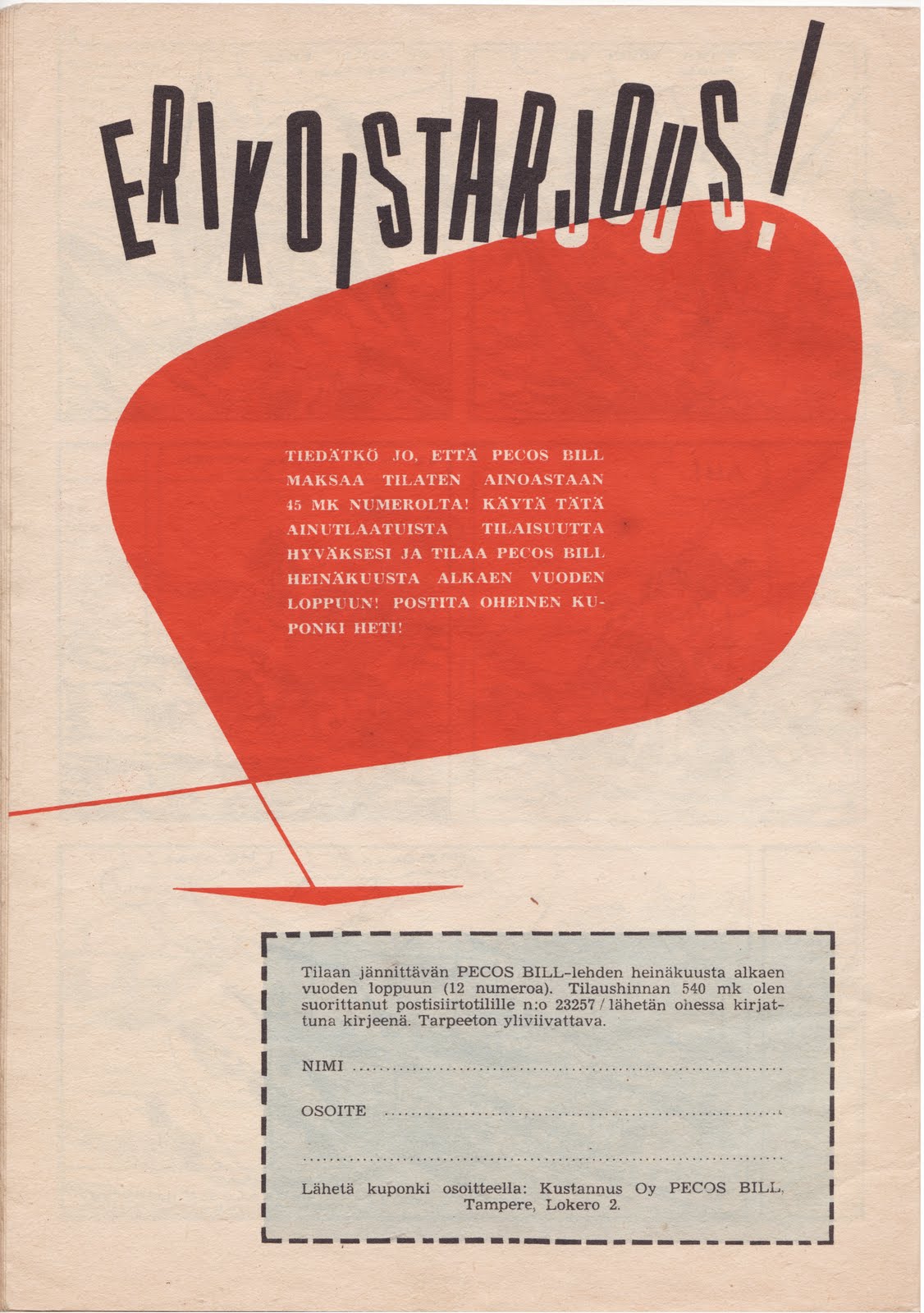
Tilauskuponki loppuvuodelle.

Pecos Bill -57:n (maailman suurimman sarjakuvakirjan) ja Lassie - Intiaanipäällikkö-kirjojen tilauslomakkeet.

Takakansi.

Friday, 28 September 2007

Buffy Season 8: Long Way Home


Buffy Season 8: Long Way Home (#1-#4)
Script: Josh Whedon
Pencils: Georges Jeanty
Inks: Andy Owens
Colors: Dave Stewart
Letters: Richard Starkings & Comicraft's Jimmy

I just finished this. And I have only one thing to say; wow.

Before I start to talk about the comic, a brief monologue on the background should be in order; Buffy the Vampire Slayer aired seven seasons from 1997 to 2003, created a spin-off Angel which ran five seasons till 2004. Apparently TV-film about yet another character would be currently in production and come out sometime next year.
The show was ground-breaking in many ways; and to this day many of the more popular shows use plot-points and characters created here; Veronica Mars and Chloe Sullivan (Smallville) come readily to mind.

Background

The premise is pretty simple; the world is full of evil things, and vampires are pretty much the low end as far as the threats go. Slayer - always a female - who is armed with super strength, damage resistance and combat skills was created to keep humanity safe. When she falls (usually only after few years), a new Slayer awakens somewhere to continue the mission.

The TV-Show
Buffy is the Slayer. During the TV-series she and her friends went thru the education system (high school, university), had few relationships, tried to find their place in the world,, grew to be adults and finally got things working pretty well for them; at least as well as things can go when people around you die more or less frequently.
The thing that made the series great was in showing how mundane supernatural is when you are forced to live in the middle of it year after year. Even the demons have bars and have to sleep and get money somehow. And it might not be very good idea to go to the graveyard during night-time. Oh, and a looming apocalypse more or less annually, usually around May. Better leave the calendar open.

The Comic
It has been few years since the season seven ended. And as Buffy notes, the problem with changing the world is that once you do it... the world is all different. You have more responsibility, and there is nobody to tell you how things should be done. Because everything is new. The book has a nice balance between returning to the characters of the TV-show and telling how they are doing after we last saw them. And even as we follow combat training and assault to military installation, there is still time to catch on how the characters personal lifes have been going, why Lando Calrissian's outfit bode bad for the future (Ewoks!) and wonder who in the cast was harbouring true, unrequired love towards Buffy..


The goodness
If you didn't guess, I'm a huge fan of Buffy (and I don't use that word lightly), so I was a bit unsure how to aproach the comic. On the other hand, it doesn't have the facial expressions, background music or other techniques available in television, and on the other there also aren't any budget limitations for what you can and can't show.
And then there's the one limitation I was most worried off; 40 minutes of TV every week isn't the same as 22 pages of paper once a month. On top of it all I was quite worried about the deconstruction; the style of the later years to tell as little though text as possible to give more space for the art. The books look amazing, but you also read them in five minutes. This isn't the case here; text fills the space, confident that it's needed. And when a truly shocking sight comes up, it is given the space necessary. But all in all, the pages are used very economically, with only few boxes carrying minutes of conversation.
And speaking of the art; there's a certain amount of talent required to make the characters look like the actors that once did the roles, without making the art look stiff and unnatural. Save few panels with Andrew (above), the artist has avoided this in an excellent manner. Good old-school art with realistic yet simple style; no photorealism and no manga, both of which would probably ill-suit the series.

All in all; Buffy is back. With new direction and without the limitations that seemed to strangle the show sometimes during the later seasons. I confidentially wait for the new issues and the TPB's; the first one should come out in just few days.

I'll be waiting for it at the door.

Tuesday, 23 May 2006

Time Jam


Very good reason to get drunk.

From wikipedia:

...the situations typically arose from misunderstandings or ideological differences between various groups that could be resolved through reason and perseverance. The core theme of the stories is an optimistic liberal humanism: the adventures aren’t about defeating enemies but about exploring, facing challenges, and celebrating diversity.


This is one of my favorite comics. They handle more like travel journals into strange worlds than future-themed adrenaline-action with explosions every three minutes.
My favorite sequence in the comic-series was when they after tracking down drugs and illegal technology on 80s Earth, find out that the guilty party is Holy Trinity. Big is Valerian's and friends surprise when they find out that God is a no-good, down-on-his-luck business man, Jesus is an old hippie and Holy Spirit is a broken slot-machine.

Im quite sure, after seeing that intro, that Tim Jam will not be anything like that. Well, hopefully it made the creators rich.

Tuesday, 11 April 2006

Harry Potter Part I

I just finished reading the Harry Potter-series. I have known of the series since about 2001. However, I had not seen fit to read any of the books, mostly because I found the descriptions of the series dissapointing and the fans of the series annoying.

I once browsed thru book one, but didn't much think of it. Two weeks ago I loaned the first book from library again (I was really bored and I have mostly read everything else worthy there), so I thought to give it a try. The first one went down pretty badly. I didn't find it that interesting. Second was slightly better, and starting from book three I read the rest inside a day or two per book (the last book went in a day).

Anyway, now that I have finally educated myself in this phenomeon, you would be wise to expect that I will be writting several posts about the subject. That is why there is "Part I" in the topic.

Things I thought to bring up are:
1. The relationship between parents and children in the books
2. The concept of magic and "muggles" in the series.
3. How the concept of these stories relates to other stories in this and other genres.
4. Some problems I have with these series, particulary the target audience.

I do not yet know which of these concepts I will actually be talking about, it may be that I drop some of the topics in the list, and talk of other things entirely. There might even not be "Harry Potter Part II".

Anyway. I have noticed in myself that, when reading long stories on one go, I really start to live the stories. And when I close the last book, I start to feel very small and unimportant. It may be that I live thru much trough the stories, and my mundane life, that goes between school and computer (and friends during weekends) is not that interesting.

Stories that have previously caused myself such immersion could start with the David Eddings' Belgariad and its sequel Mallorean. I reread them last summer and noticed that they haven't really stood the test of time, but at the time (when I was 13) they were really great.
It was the first story I read that wasn't based just on adventure (Tarzan, Zorro, Blyton-books) or on story on epic levels (Star Wars, Lord of the Rings), but had some romance- and soap opera there too, if I may say it so bluntly. I may have talked of this previously in this blog. Since then I have felt so very strongly when I first read Rumiko Takahashi's Maison Ikkoku, Uncanny X-Men's "classic" stories (from #80's up to #250 or so), saw the 90s Superman-series (I watched the first three seasons nonstop) and a read Terry Goodkind's Sword of Truth-series (before the very dissapointing last books).

Anyway, should I have any readers, I would ask you to recommend some similar stories for me to sample. Longish, with development between and with the characters.

Saturday, 25 March 2006

Success!

Three weeks ago I volunteered to review a newspaper strip-collection. The publisher even sent me a review-copy - so this was "real" review, not one of those where I have to buy my own copy which I will then publish at some forums or on my blog.

It saw the light of day at Kvaak.fi, which is the biggest* comics portal in Finland. The forums are read by all - the publishers, the editors, translators, artists and writers - and so it's not just some "fan project".

The review is in finnish and can be found here. It has been up for four hours now and the page has 70 hits - on Saturday.
Apparently my text wasnt awfully sucky, as I was asked to review some comics for Otaku - which is THE fanzine for anime in Finland*. I'll probaply not get paid, but Ill get more copies for review. As albums aren't that cheap for poor student like me, free stuff is free stuff even if I have to write a review about it. (My dad pointed that it isint free if I have to review it, but as I would probaply write a review anyway, I think this is pretty cool).
Hopefully, in a few years I get my texts up in Sarja-Info, the four-times-a-year magazine published by Finland's Comics Society. That is, if I can keep writing that long. But it would be really great to see my name in print somewhere.

Well, dreams are important, don't shatter them, please.

*OK, so theres only one
*There are others, but this is the only one with regular publishing schedule.

Saturday, 17 December 2005

Comicbook logic!

Comics are a great thing. There are several reasons, and one of the most coolest thing about particular brand of them is the continity. Yes, Im talking about superheros.

Continity - that is, things from past storylines affect the future ones - is a cool thing. Sometimes it also causes problems. Things are made for one particular storyline, that become obvious hinderstones in later ones. Or some machine (usually weapon) has some really obvious beneficial uses, but the heroes (even if they have resources, and even if they themselves are in need of the beneficial use) never get around doing it.

The most obvious examble, of course, is Professor Charles Xavier, the founder of X-Men. As you might remember from the movies (in case you dont read comics), the man is a cripple; he moves around while sitting in a wheelchair. This is quite strange, while we remember that the man teaches and houses people of great healing power under his roof. Several times, these healers have been shown to cure battlewounds that would cause death inside minutes; mending bones, removing holes thru the stomach and what have you. And still, Xavier has not asked, nor has of the healers suggested, that Xavier himself could be healed.

Or Cyclops. The man can shoot conclusive rays from his eyes (eg. he shoot beams that have the same effect as by being hit by cannonball). Thanks to brain damage as a kid, he can never turn his rays "off", and therefore he has to use visor that makes his rays harmless when not fighting people. He could be healed, as detailed above, but there are other solutions. X-Men have fought villains, and sometime they have lost. And the villain has chosen to imprison them by using "Inhibitor Collars". In short, it makes using superpowers impossible; shorts them out. They are well tested - in Marvel Universe, there were a whole islandnation full of mutants who were made to use them - so research in the technology is well betatested, and quite safe for users. So, why hasn't some company reverse-engineered the technology and built, for examble, bracelets with on/off switch? Cyclops wouldn't need those glasses, Rogue could touch people without taking their memories and so on. And thats just in the X-Men. Worldwide, there must be thousands, if not hundred of thousands, who look pretty normal and would like the comfort of knowing they dont accidentally, say, level a house. And people whose powers make normal life impossible. Naturally, it wouldnt help always, but it would help SOMETIMES. And even if the bracelet would cost tens of thousands of euros... goverment might help with the fees (it would limit damage to buildings), and even if it wouldnt - how much would you pay for item that would let you touch people without killing them? It should cost very much indeed that I wouldnt get one. There are loans, you know, and item like this would probaply have lifetime waranty.

Other things well known in Marvel U, but not used by anyone outside hero/villain community: time machine (with "ghost mode", where you can observe past but not affect it - ideal christmas present for any archeologist or historian!), alien civilisations with very advanced technolgoies and benevolent mindset (eg. ready to share, not trying to invade), Asimovian robots, force fields, 3D-technology, VERY advanced computers, flying cars, get-superpowers machines (several, most quite safe for the user) and so on. Seeing as some superheroes and villains are also involved in business, not seeing these things in the market is quite amazing (Fantastic four is financed by patents, Iron Man and Iron Fist own tech companies, Black Panther is the head of state, X-Men has several millionares and company owners and Batman is one of the richest people in the world).

Then there are those very absurd things, such as in DC's Flash. One of the villains is Dr. Alchemy. "Ha Ha Ha! After years and years of research, I have finally invented the Alchemist's Stone! With it I can change any material into another! Let's go rob some banks, instead of making copper, silver, iron, platinum, aluminium or some other very valuable and/or rare metal that is used in machines!" And of course, the men who just happen to discover how to make power armours, freeze guns, stilt legs (allowing you to rise to hundreds of meters, while keeping your legs on the ground), power sources and what have you. They could make millions if they started selling their inventions instead of trying to rob the bank down the street!

Oh, and it is shown that Batman's company, Wayne Enterprises, had in the middle eighties a machine that allowed people with broken backs to walk again. Problem was, back then the machine weighted 20 kilos or more, and must have been used all the time. It was 20 years ago, and surely the tech has evolved. And/or, Batman could have pushed more money in the technology, seeing as his friend, former Batgirl and current hacker and manager of Batman's information, happens to suffer from just this condition. Pretty indifrent, isin't he?

While, obviously, some of these things may have violent uses, and some heroes may want to keep their heads out of the workings of humankind - such as Superman - I cant really see why Iron Man, who owns a high tech company with army contracs, would hesitate to put into the market such things as 3D-projector (seeing as he wants to develope the company more to the high tech, consumer market). And time machines (which cant be used in Marvel U to change present) could and should be owned by at least several universities, however ridiculously expensive they were.

So many heroes could help so many more people than they do, if they just would think a moment more of the technology they smash and broke in every issue of their comic books. Sure, they are malevolent, but cant the underlining technology (and applications of physics) be used for GOOD? And why wont villains, that are are shown to be only concerned with money (and not say, world domination) sell or licence their patents instead of robbing banks?

But of course, these are comic books. But some technology could be incorporated into the the universe without making it look very foreign from our own; and that which cant could easily be explained away. But they dont do either, and this makes the heroes look very stupid indeed. Even if some of them are Nobel-winning scientists or supergeniuses.

Monday, 3 October 2005

Midnight Nation

This is not a review. Review is about telling you if something is worth reading. This is something else. But in case you havent read JMS' Midnight Nation - a story about a man who has lost his soul and has to walk from Los Angeles to New York in one year, before he turns into a monster - I definetly recommend it. It's probaply the best single story from the man who did Babylon 5, Rising Stars and a long run of Spider-Man, as well as punch of other stuff for telly, comics and printed books. Also, if you havent read Midnight Nation, and you are going to give it a try (and I assure you, it is worth the trouble to get it), I would urge you to stop reading here. Because Im going to spoil some twists in this now, and you are better off not knowing.

I want to talk to you about Laurel, you know, about the woman who walks with David Gray, the protagonist, from one shore to another. A friend of mine said that the books worst single problem was the plothole about Laurel, how she went for the "long walk", even thought she was at peace in the In-Between.

Few quotes:
[About to be called to help David, talk with God, perhaps?:]"I don't want to do this. I can't face the pain again." "PAIN IS INESCAPABLE" "Not if I stay here." "THEN YOU SUBSTITUTE ONE KIND OF PAIN FOR ANOTHER." "I dont want to die."
[Talking about her life between trips:]"I'm... at peace. But unfulfilled. Empty. Waiting. I don't want to wait, but I do. I dont't want to stay, but I do. I don't want to go, but I do. I'm In-Between. But it's better than the pain."

In a nutshell, Laurel could have stayed in the In-Between. And like my friend said, she was in peace. But it was not lasting peace, it was uneasy peace. Like when waiting for something in the receiving room. You have comfy chair, maybe some periodicals. But you know that it can't last. And while you are at peace, you know you will be called forth. It was, however, great improvement over going back into the world and having to receive the pain of the journey. The only reason why she would do this, would be, ofcourse, for the vain and nearly nonexistent hope that she might get lasting peace out of it. And as the story makes very clear, she had tried this so many times, and it was all for nothing. She didn't believe in the final peace no more.
She was doing it as a reflex, because she used to have hope in this, and while she didn't anymore, it was something she had done.. and was still doing, even thought she didnt necesarily believe in it no more.

Saturday, 3 September 2005

Found this...

Carl Barks made some really cool cartoonboxes. Check this and select something under the OBJECTS AND IDEAS. Some really funny stuff.

Tuesday, 26 July 2005

GLA Misassembled

Last week, Marvel finished GLA Misassembled miniseries (four issues), written by Dan Slott and drawn by Paul Pelletier.

The comic is about Great Lake Avengers - a "superteam", whose members powers are either useless or politically incorrect. The team consists of Flatman - who is as thin as paper, Mr. Immortal - who can die but not stay dead, Doorman - who can teleport stuff about two meters trough his "black hole" body, Dinah Soar, who looks like some flying dinosaur (and can fly, but not talk), and Big Bertha - really goodlooking anorectic woman, who has the ability to become superstrong (and superfat) superhero. She disposes her weight by thowing up. Works as supermodel in her civilian identity.

The story centers around quest for new members. You see, GLA members have this annoying habit of dying (Mr. Immortal dosent count). So they need to recry new members. But everyone knows GLA, and nobody wants to join. The second tread of the story is about Mr. Immortal, and why he cant die (they illustrate his suicide attempts really well).

The comic is all about humour. The first issue is about the history of Mr. Immortal and GLA, the second issue is for the quest for new members, third issue is about the villain attack, and in number four it all ties back together.

The comic is fun - nothing is funnier that squirrel named "Monkey Joe" giving good tips for life ("Friends dont let friends play the Magnolia soundtrack", "please dont do what you see Mr. Immortal doing in this issue.."). On the other hand, its also sad - the GLA members are really sympathic punch, and when the comic is about destroying the team... Good reading, though.

Its different from Giffen/DeMatteis JLA-stories, to whose fans this comic was obviously intented, considering the logo-design, and nearly equally good with the best of JLA-stories of the era. Expect, of course, this is more sad, and dosent potrait always the heroes in so positive light as JLA did (they were, after all, the premiere superteam of their world).

Recommended.